

If you’re getting into yerba mate, understanding the different types of yerba mate bombillas (pronounced bom-bee-ya or bom-bee-sha) is essential.
The right one can completely change your drinking experience, from how well it filters to how comfortable it feels to use.
Many people end up trying multiple bombillas before finding one they actually stick with.
In this guide, you’ll learn the most common types of bombillas, how they differ, and how to choose the best bombilla for your setup.
If you’re looking to explore different styles as you read, you can browse our full collection of bombillas.
What Is a Bombilla? (Yerba Mate Straw Explained)
A bombilla is a straw with a strainer on one end to allow you to drink yerba mate without the leaves entering your mouth.
They're most commonly made from materials like stainless steel or alpaca (nickel silver), and come in different shapes and designs. Some use a spoon-shaped filter, while others use a spring or coil system.
Let's take a look at each one below.
Types Of Bombillas (By Filter Mechanism)
There are many sizes, shapes, and designs to choose from. But in general, they all fall into three categories in how they actually strain the yerba.
Here's a short video so you can get a good visual of what I'm describing.
The three categories are as follows:
Holes
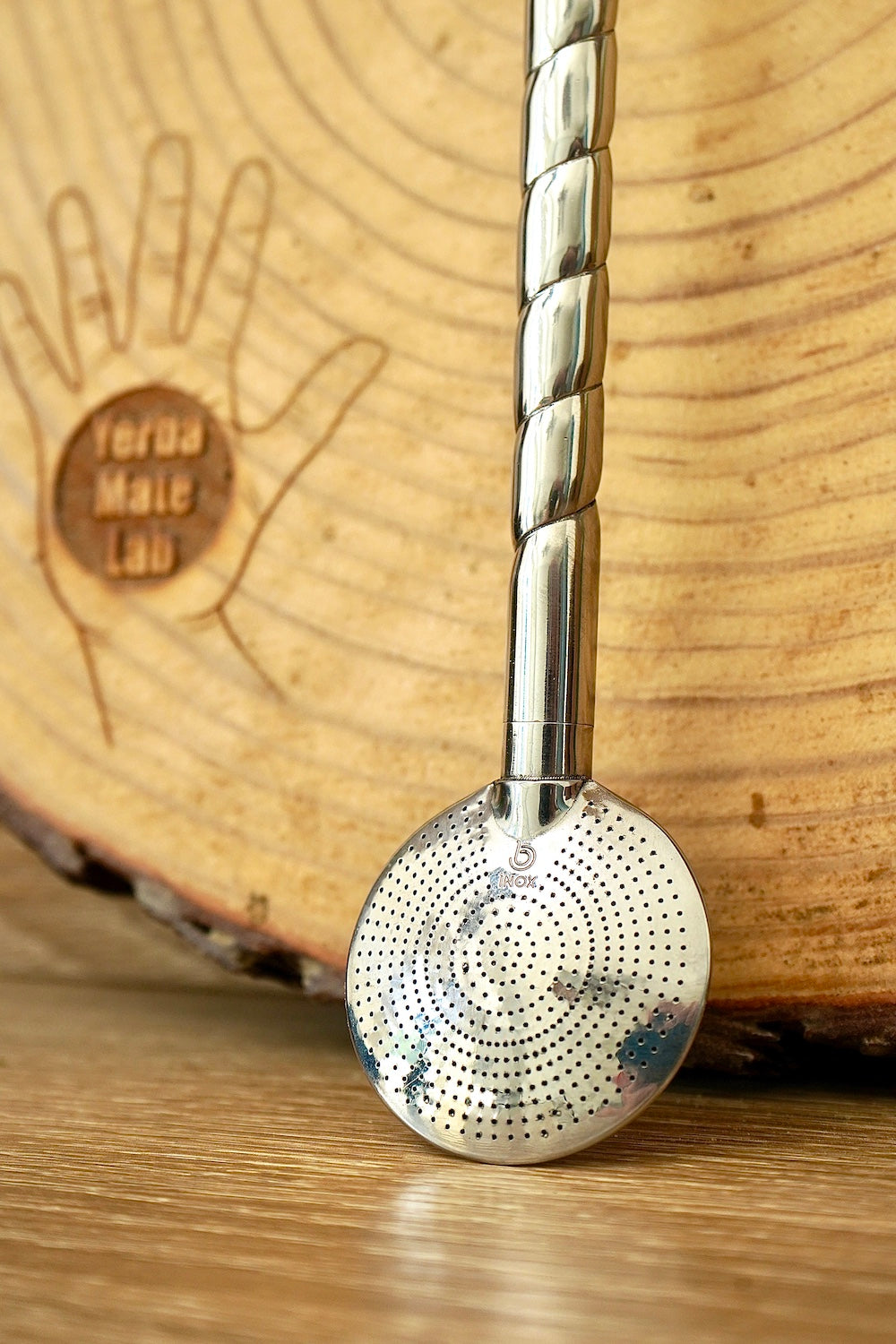
The straw has a filter head that is perforated with tiny holes on the front and back. The pattern and number of holes can vary as well. Some are in a circular pattern, some in a T-shape, and some even in the shape of an object, though rare.
Slits
This is typically found on bombillas with a flat design, and the slits either go across the long portion in the front and back, or on both sides of the tubing.
Coil/Spring
These are either a tight coil attached to the straw's tubing, where the spaces in between serve as a filter. Or there's a spring fixed to the end of the bombilla, which already has holes on it, to serve as another layer of filtration.
Types Of Materials
When shopping for a bombilla, you'll only really come across three materials - stainless steel, alpaca silver (nickel alloy), and bamboo.
Stainless Steel
Stainless steel is a popular material we're all familiar with and they're the best all around. They're durable, easy to clean, and perfect for everyday use.
Alpaca Silver
Alpaca is a metal alloy made from copper, nickel, and zinc. It's a traditional material often used for bombillas and for the rims of mate gourds. This material is highly malleable and allows makers to craft elegant designs with it. However, it can tarnish and will require regular polishing to keep them looking new. These are great for those looking for an authentic experience and more ornate bombilla.
Bamboo
Bamboo is another traditional material but doesn't offer much when it comes to filtration or design. They're usually made with a handful of holes poked through the bottom end. And being that it's a natural material, they also run the risk of becoming moldy. These are fun to have in a collection but not the greatest in a practical sense.
Why Spoon Bombillas Are The Best
Over the years, I've used all types of bombillas and the best one is a spoon filter with holes.

This isn't to say the other ones don't work. But if you want something that works for all types of yerbas, spoon bombillas are the non-negotiable.
This is the only type that works with coarse-cut Argentine yerbas, all the way to extremely powdery Brazilian chimarrão. If you don't think you'll go out of your way to try that, then the other styles are fine.
But here's the question: why even bother with the other types if you know a spoon bombilla filters better than anything else?
It's for this exact reason that we decided to only sell this type of bombilla on our shop. But even these aren't all made equal.
Round VS Pear-Shaped Filters
When looking at spoon bombillas, they come in either a round shape or a pear shape. And as named, round shapes are a perfect circle, while pear shapes are more like a pear or teardrop (previous picture).

Comparing the two, a round shape tends to do better than a pear shape, as the latter typically has a wider amount of space between the front and back of the filter. And that open space in between can make drinking slightly tougher. This isn't always the case, though, as some filters are thinner and almost touching.
But to be clear, this is a minor detail.
The difference between a round and a pear shape isn't noticeable to the point that you should avoid one for the other. But it is a quick thing to note when wanting the best option possible.
And now that you know a round filter with holes is the best thing to look for, here's a version of that, but better...
The Best Bombilla For All Types Of Yerba

This is the 1000-hole bomba (bombilla in Portuguese) and it is the best bombilla you can buy.
>It's made in Brazil by the company Bortonaggio and features a revolutionary, one-of-a-kind design. No other company has a bombilla like this as far as I'm aware. And just by the name and picture, you can probably tell why it works so well.>
The More Holes, The Better The Filtration
Compared to typical spoon bombillas, which may have around 100 holes total, the 1000-hole bomba has a thousand holes (mil furos in Portuguese).
But it's not just that it has more holes, but that the holes are smaller.
And of course, the smaller the holes, the fewer particles get passed through.
Not all of them have a thousand holes, though. Bortonaggio actually has two sizes: one with 800 holes, which has a smaller filter head like the one above, and one with 1000 holes, which has a larger filter head.
800 Holes VS 1000 Holes
You might be wondering if there's a difference between the two sizes. And in my experience, there definitely is.
The 800-hole works great and is a lot better than regular spoon bombillas. It clogs less and lets fewer particles pass through. With Argentine, Paraguayan, and Uruguayan yerbas, it's an absolute breeze. With chimarrão, it's not 100% solution, but clogging is a lot less likely.

And it's even less likely once you use the 1000-hole one. Where the 800-hole would clog or produce resistance, the 1000-hole doesn't. Compared to everything out on the market right now, there's just no beating this when it comes to filtration.
Removable Filter For Easy Cleaning
The Mil Furos Bomba also features a removable filter head for easy cleaning. So after each mate, you can unscrew it and give it a good rinse to ensure no particles are left in the filter.
And to top it off, we also include a cleaning brush with each one that you can push through the tubing and filter head for an even deeper clean.

What About Slits, Spring, & Coil Bombillas?
These types are usable but really only thrive with coarser cut yerbas like ones from Argentina or Paraguay.
With fine-cut Uruguayan brands, they can also work but are at more risk of clogging. And when it comes to chimarrão, it's near impossible to work.
So unless you only plan on drinking Argentine/Paraguayan yerbas, these are not recommended by us.
What Size Should Your Bombilla Be?
One of the biggest mistakes you can make when getting into yerba mate is buying a straw that's way too big or way too small for your gourd.
In general, we recommend a bombilla length around 7-7.5 inches (18-19cm). This size will fit the depth of most mate gourds which tends to be about 3-3.5 inches (7.6-9cm). A good rule of thumb to follow is for the straw to be no more than double the length of the depth of your gourd.
Any larger and it looks way too long. Any shorter and it looks too short.
Do You Need A Bombilla To Drink Yerba Mate?
When most people find out about yerba mate, they’re only exposed to the traditional way of drinking it - in a gourd with a bombilla.
But yerba mate can be prepared the same way as tea or coffee. Whether that be with a tea strainer, tea pot, coffee maker, moka pot, you name it. As long as the yerba is able to be steeped in hot water and strained, it can work.
Now that you know everything you need to know, if you're ready to get one, we offer plenty of different yerba mate bombillas on our shop - all made from durable stainless steel so they can last you a lifetime.